Showing posts with label Rover. Show all posts

Rover 400 / 45

Rover 400 (later the Rover 45) is a series of tourism, truck, and (later) five-door models, produced by the British manufacturer Rover from 1990 to 2005. The car has been jointly developed in collaboration with Honda, Rover, the two generations of the car were calculated from the redesigned Honda chassis, the first Honda Concerto and later, the Honda Civic.


The original 400 series, released as a four-door sedan in early 1990, it was only a sedan version of the sedan in the second generation Rover 200 series, both share the code name during development of the R8. Like the 200, the model was designed in collaboration with Honda (who produced the corresponding model designed for the Concert of Europe) and the two models that share production lines at Rover plant at Longbridge. He used the same basic structure and mechanics as the Honda, but the new design of the rear caliper and body are unique to Rover. Architecture Interior trim and electrical systems were shared with all the 'R8' Rover 200.

A succession - or break - version was later developed by Rover Special Products. Badged as the Rover 400 Tourer, it remains in production since the second generation of 400 to 1998, because no station wagon version of the car were built later. R8 Rover 200 and 400 are the first applications of the family Rover K-series engines (listed in 1.4 L (1396 cc) twin cam 16-valve form). The 1.6 liter (1590 cc) version used, a Honda D16A8 D16A6 SOHC or DOHC power supply, while the 2.0 L M-Series 800-unit series soon followed (1991) in versions sports. engine models Rover drove the front wheels through jointly developed gearbox Peugeot / Rover R65 (1.4 liters) and an integrated license PG1s Honda designed at 1.6 and 2.0 liter versions.

Also available are two diesel engines of PSA, with the choice of aspirated 1.9-liter turbo or 1.8 XUD7T XUD9 engines. They settled in the place of Perkins Prima used in the Austin Maestro and Montego because the combustion engine with its heavy was too thick for new models. A facelift midlife (also applies to the Rover 200) saw the reintroduction of the Rover grille has also reappeared in the remodeling of the Rover R17 800. This change was accomplished without significant alteration of the remaining structure, but always a 'family' more distinctive Rover and establish some distance from the Honda Concerto.

Rolls-Royce Ghost

Rolls-Royce is a luxury sedan Rolls-Royce Motor Cars. The (ghost) label, the name in honor of the Silver Ghost, the first car produced in 1906, was announced in April 2009 at the Shanghai Motor Show. During development, the ghost was known as the (RR04). Designed as a little (more measured, realistic cars) that the ghost with a view to a category of lower prices for Rolls-Royce models, the selling price is 170,000 pounds ($ 255,000 USA). The production model was officially unveiled at the Frankfurt Motor Show 2009.

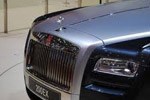
The original concept car, the 200EX name was officially unveiled in Geneva in March 2009, which indicates the direction of Ghost-style production model. Unlike the aluminum-bodied Phantom, the 200EX is steel, which has a higher tensile strength and therefore can be thinner. The chassis uses a smart suspension system on all fronts of air and aluminum and multilink rear axle. Systems such as Active Roll Stabilization, four corner air springs and variable damping function as a single control, so imperceptible to the driver and passengers to provide the best possible comfort for the occupants. Connected to the mainframe, the suspension is capable of detecting the movement of one side of a back seat to another, and compensates accordingly.


The Ghost was designed by Ian Cameron and directed by Helmut Riedl, who led the development of more than Rolls-Royce Phantom. Ghost, codenamed RR04 during its design phase, was designed to compete with vehicles far less expensive than the Phantom, as the Bentley Continental Flying Spur.

The Holy See borrows 20% of their parts for the BMW E01 platform, which underpins the current BMW 7 Series. The Phantom has a 129.7-inch (3290 mm) wheelbase, roof height, bonnet height and track gauge of their own, and the Holy uses air springs ghost style. The car also shares the FlexRay system electronics. BMW supplied parts are used in places without being seen by the driver functional. The car weighs 5,445 pounds (2,470 kilograms) on the sidewalk.

The engine is a 6.6 liter V12 twin-turbo engine with variable valve timing, rated 563 horsepower (420 kW) produce 780 newton-meters (580 ft • lbf) of torque, automatic transmission ZF 8-speed.The engine allows the Ghost to accelerate from 0-60 mph (97 km / h) in 4.7 seconds and reaches an electronically limited top speed of 155 mph (249 kmh).

Renault Laguna

Renault Laguna is a family car produces large French manufacturer Renault. The first Laguna was launched in 1993, the second generation was launched in 2000, and the third generation was sold in October 2007. Renault cars for normal production, are not related to the concept car has the same name, Laguna, is a two-seater roadster model cars at the 1990 Auto Show circuit. formerly known as the 1973-1976 Chevrolet and top-of-the-line Chevelle, Chevrolet Chevelle Laguna.

The first generation Renault Laguna was launched in December 1993 as the successor of Renault 21, which originally comes as a sedan only. Towards the end of 1995 brought a wagon version, called in some markets as the Laguna Sport and replaced the 21-based Renault Savanna / Nevada.

Laguna's equipment levels gradually increased. All later models came with power steering, electric front windows, driver airbag and central locking as standard. Most of the range has dual airbags, antilock brakes, air conditioning, CD player and is a standard or optional equipment.

Renault Laguna More Photos:

Porsche Cayenne

Cayenne SUV is a luxury five-seat mid-size produced by the German manufacturer Porsche since 2002, with sales in North America, beginning in 2003. His platform was developed by Porsche and shared with the Volkswagen Touareg and Audi Q7. It is the first V8 vehicle built by Porsche since 1995, when the Porsche 928 was discontinued. Since 2008, all direct injection engines as well. Number Cayenne chassis type are as follows: Type 955 (2002 - 2006), Type 957 (2007 - 2010), and Type 958 (2011 +) Show. The second generation Cayenne (Type 958) was unveiled at 2010 Geneva Motor in March for a line indicates February 25, 2010.


Part of cayenne and doors are Volkswagen, which uses frames and doors for the Volkswagen Touareg. All other aspects of vehicle design, setting, production takes place at the home of Porsche.

The GTS is powered by a V8 with 405 hp from 4.8 liters and features a sports suspension and 21 inches (530 mm) wheels. It is lighter than the Cayenne S and has an aerodynamic body kit. Porsche Cayenne GTS is a time of 0-60 mph (97 kph) in 5.7 seconds. six-speed manual gearbox is also offered.


The first generation of the Cayenne Turbo had 450 horsepower (340 kW) and accelerates from 0-60 mph (97 km / h) in 5.3 seconds. Turbo S version was built in 2006 to compete with the Mercedes-Benz ML63 AMG. The Cayenne Turbo S includes a low range box, differential lock, and adjustable ride height, terrain, also standard on the regular Turbo model. It was powered by a 4.5-liter twin-turbo V8 that produces 520 horsepower (390 kW) and 700 Nm (520 lb-ft) of torque. Acceleration from 0 to 60 mph (96 km / h) was 5.0 seconds and top speed was 171 mph. There was a 6-speed Tiptronic transmission automatically.


The base model is powered by a 3.2 liter engine producing 250 hp VR6 (190 kW) changes in the exhaust manifold to allow for peak power at 6700 rpm. This is the same 3.2-liter engine found on a Volkswagen Touareg and Volkswagen R32. A turbo diesel is also available. Acceleration from 0 to 60 mph (97 km) is 7.5 seconds with manual transmission and 8.1 seconds with Tiptronic S. In particular, independent tests produced a time of 9.2 seconds for the diesel Tiptronic.

The S is powered by an 8-cylinder engine of a dry sump lubrication system and variable valve timing. Cayenne S engine produces 340 hp (250 kW) and 369 · lbf ft (500 Nm) of torque. Acceleration from 0-60 mph is 6.4 seconds and a top speed of 155 mph.

Peugeot 307

The Peugeot 307 is a C-segment car produced by French manufacturer Peugeot since 2001. He was awarded the European Car of the Year 2002 title, and continues to be offered in China and other South American markets through 2009 despite the launch of the 308 French (his successor planned) in September 2007.


The 307 was introduced as a prototype in 2000 Prometheus 307 Mondial de l'Automobile. The production hatchback versions were introduced to European markets in 2001 as successor to the Peugeot 306. The 307 was also sold in Australia, New Zealand, Asia, and (in the petrol versions 1.6 and 2.0) of Mexico. In Brazil, the 307 ships with Flex 1.6 and 2.0 (gasoline / ethanol) for the engines.307s use the modified chassis 306, which can also be found in the Citroën Xsara Citroen ZX and 1991. However, the car is more than 306 in each direction.


The 307 continued corporate style the first time on the Peugeot 206 and Peugeot 607th With headlights and a hood upswept surge leading to a highly sloped windscreen (and rear doors vertical face to 206), the 307 has left the Pininfarina-designed themes employed on the two previous generations of the Peugeot introduced the Peugeot 205 and ending at the 406th (evolutionary) Peugeot Its height is 1510 mm (59.4 inches) which is in the middle of spectrum between small family cars (between 1400 and 1450 mm) and compact MPVs (between 1600 and 1650 mm). Some consider that 307 a low compact MPV rather than a small family car high, because of its size and profile.

At launch, the 307 was launched as a 3 - and 5-door hatchback, though in 2002 the 307 range was expanded with the introduction of two fields, called the 307 Break and 307 SW. Outwardly, they are almost identical, except that the SW version has silver roof bars and roof glass 3 / 4 length panoramic as standard equipment. Internally, however, the jump of 307 is a classical field, while the SW has a third row of removable seats so it is more flexible because of its similar minivan configuration. The SW exists because Peugeot did not develop a compact MPV spin-off he did with the Citroen Xsara Picasso, instead preferring to offer a more flexible, while maintaining the style and manners of a real road.


307 CC cabriolet with a retractable hardtop, was launched in 2003 to compete in the new European coupé cabriolets. In 2004, the four-door sedan version of the 307 was launched in China. 307 is produced in China, Dongfeng Peugeot Citroen Automobile, a joint venture of PSA. This model is also built in Argentina since early 2004.