Showing posts with label Opel. Show all posts

Opel Insignia

The Opel Insignia is great family car designed and manufactured by Opel, the German subsidiary of General Motors (GM) since 2008, which will replace the Opel Vectra. which was launched in 2008 British International Motor Show in London, the Opel Insignia, the name of the UK market. the name of Opel Insignia is used throughout continental Europe and Ireland and North America and Chinese markets branded versions of the Buick Regal. the Buick Regal is also available in North America at the end of 2010. Chile remains Insignia Vectra Chevrolet Vectra name of the previous model. the Insignia is the first production car to feature double action in front of the camera traffic sign recognition. Insignia selected for the 2009 Car of the Year.
The Insignia is 30 millimeters (1.2 inches) more space than the knee Vectra. Both body variants have identical 4830 mm (190.2 inches) in length and share the same wheelbase of 2,737 mm (107.8 inches).


Since the launch offered a range Insignia 1.6-liter straight-four engine 1 produces 85 kilowatts (116 hp, 114 hp) 1.8-liter version produces 103 kilowatts (138 hp), a 2.0-liter straight- Family II, four gasoline turbo direct injection produces 162 kilowatts (217 hp), a Holden built 2.8-liter V6 High Feature turbo gasoline engine produces 191 kilowatts (256 hp) and turbocharged 2.0-liter 'right-CDTi' four diesel engines that produce 81 kilowatts (109 hp), 96 kilowatts (129 hp) and 118 kW (158 hp). These CDTi diesel engine of Fiat / Opel JTD.


The engine lineup was expanded in early mid-2009 with a 1.6 liter gasoline turbo develops 132 kW (177 hp) and the variation quarter to 2.0 liters 'CDTi' diesel that produces 140 kilowatts (190 hp) twin-turbo form [6]. The latter, A20DTR engine code has been delayed until at least 2011 by Saab, which manufactures the device in its models are now part TTiD Nor GM. [Edit] The nine engines meet Euro 5 emission standards, and all offered with the exception of the front wheel drive configuration of 2.8 and 2.0 liter gasoline turbo diesel bi-turbo, offered with the Saab XWD all-wheel drive as standard. With the 2.0-liter turbo, both forms of propulsion available. six-speed manual or automatic transmission is fitted across the zone, but five-speed automatic used on engines of 1.6 and 1.8 liter of gasoline and diesel baseline.


Also started in 2009, is a low-emission 2.0-liter diesel ecoFLEX variant must begin sales. Using modified aerodynamics and motor control, the model of carbon dioxide below 140 g / km, which corresponds to about 5.0 L/100 km. Power output is rated at 118 kilowatts (158 hp), but this engine and transmission to eliminate the possibility of defining (FlexRide) as an option in some markets. Later, in 2009, the high performance version of the 2.8-liter V6 turbo form will be fitted with Opel Performance Center (OPC) and VXR variants provides 239 kilowatts (321 hp). In September 2010, 2.0 CDTi diesel variant is now available with Adaptive 4x4 (4WD). It is currently only available in 2.0 and 2.8 liter turbo gasoline variants, and complements the programming one.

Nissan Maxima


Nissan Maxima is a full-size car produced by Nissan, which is marketed as a (sports car with four doors). Maxima began in July 1976, an exclusive version of the Bluebird and was spun into its own line in 1980, having been made continuously since then. Most pre-2004 Maxima has been built in Oppama, Japan, until the current North American Maxima began to gather in Smyrna, Tennessee. The Maxima models are also known as Nissan Cefiro or Nissan Laurel in various markets.


The model line began with the Nissan Bluebird Maxima Maxima, which was available in the U.S. as the Datsun 810 in February 1977. Is powered by two versions of the series of engine displacement 2.0-liter SOHC I6 for the Japanese market and 2.4 L (as in the Datsun 240Z) for the U.S. market. Bluebird Maxima used a carburetor for the base model and fuel injection for the sporty version. The 2.0L engine was good for 122 hp JIS (90 kW), while the larger engine of America could reach 125 hp SAE (93 kW). The sporty version of energy channeled through a four-speed manual transmission. These cars were rear wheel drive and had a semi-final arm rear suspension. station wagon variant had the rear axle line, for reasons of accounting charge.


2-door coupe version was introduced in 1979, and external update, and was available only in the composition of the Maxima is a Datsun 810. New Datsun 280ZX divided into 810's chassis, while 810 did not get bigger 2.8-liter engine car.

Mitsubishi Lancer EVO

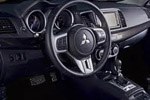
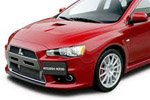
The Mitsubishi Lancer Evolution, colloquially known as the Lancer Evo or Evo,is a high performance sedan manufactured by Mitsubishi Motors. There have been ten official versions to date, and description of each model is a Roman numeral. Any use of two-liter turbo engine and four-wheel drive systems.


Evolution was originally intended only for the Japanese market, but market 'gray imports' demand led the Evolution series offered through the network of Ralliart dealers in Italy and in several European markets around 1998. Mitsubishi decided to export the eighth generation Evolution to the U.S. in 2003, after witnessing the success Subaru had in that market with their Impreza WRX, a direct competitor in other regions of the world.


The Japanese-spec cars were limited by a gentleman's agreement to advertise no more than 280 hp (206 kW, 276 HP), a mark already reached by the Evolution IV. Therefore, each later developed informally by the figures given power, with Japan-spec Evolution IX reach a claimed performance of about 321 PS (236 kW, 317 hp). Different versions available on other markets including the UK, have official power outputs up to 411 hp (302 kW, 405 hp).


The original was involved in the Lancer Evolution World Rally Championship. He used the turbocharged 2.0-liter DOHC Transmission 4 wheel drive of the original Galant VR-4 in a Lancer chassis, and was sold in GSR and RS models. The latter was a club was eliminated by running the version that had no windows and seats, antilock brakes, a rear wiper, and had steel wheels weigh about 70 kg (154 pounds) less than 1,238 kg (2729 pounds) GSR while the former comes with all the comforts of a normal road car. It came with Mitsubishi 4G63 engine producing 247 hp (182 kW, 244 hp) at 6000 rpm and 309 Nm (228 lb-ft) at 3000 rpm. 5000 of the evolution of the first generation were sold between 1992 and 1993. The maximum speed is 228 km / h (142 mph)

Mini (BMW)


Mini (MINI style) is a British car brand, which specializes in small cars owned by BMW. Emerged as a mini car, small car originally known as the Morris Minor Mini, launched by the British Motor Corporation in 1959 and evolved into a brand that includes a range of small cars, including the Clubman, Traveller and Moke. The original Mini continued production until 2000. Development of a series started in 1995, and the new generation of the car (organized by MINI to distinguish it from its predecessor), was launched in 2001. The current range includes the Mini Clubman (estate), convertible Countryman (crossover) and Hardtop (small family car).


Mini incorporates Cowley, Oxford, United Kingdom, where about 4700 people employed. Motors Mini cars produced in the plant in Hams Hall near Birmingham, United Kingdom, which has about 800 employees. Mini-sub-assemblies such as doors and extrusions to provide the plant in Swindon, United Kingdom, where about 1,000 people at work. Approximately 217 000 Mini sold worldwide in 2009.


Mini brand has had several owners during its history. In 1966, the British Motor Corporation has become part of British Motor Holdings in 1968 and British Motor Holdings merged with Leyland Motors to form British Leyland. In 1980, British Leyland was broken and in 1988 the Rover Group, including the Mini had been bought by British Aerospace. In 1994, BMW bought the Rover group. In 2000 the group had broken up Rover, BMW and the BMW Mini brand to keep.

MG XPower SV

MG XPower SV (Sport Veloce) is a sports car, which was produced by MG Rover. Produced in Modena, Italy and ending at Longbridge, United Kingdom, was based on the platform of anxiety Mangusta, formerly the De Tomaso Bigué.


After acquiring the anguish Automotive Srl of Italy, awarded MG Rover X80 project code and create a subsidiary, MG X80 Ltd. to produce a new model based on the Mangusta anxiety. One attraction is the potential sales in the U.S. since the Mangusta had already been approved for the U.S. market.

MG X80 was unveiled as a concept car in 2001. However, the style seen as static. When the production model, renamed the MG XPower SV, has finally launched the following year it was designer Peter Stevens has made the car a more aggressive style. Transformation of a clay model for a production car, including all applications, was completed in just 300 days of the Swedish company Caran. One objective was to obtain a list price of less than £ 100 000. original model of the car ended up costing 75,000 pounds ($ 150,000) with downgrade XPower SV-R model costs £ 82,000 ($ 164,000), despite the fact that several of the cars outside and interior parts were taken from the Fiat, past and present. The headlights, for example, the roof comes from a Punto Mk.2 and taillights borrowed from a Fiat Coupe.


The production process was complex, partly caused by the use of carbon fiber body panels. The basic body parts were made in the UK by SP Systems and then shipped to Belco Avia, near Turin for assembly into body panels. They then met in a full body and mounted on the frame of the picture frame and running gear and sent to the MG Rover factory in Longbridge to be cut and finished. According to MG XPower SV Club, about 82 cars were produced with the exception of four XP pre-production prototypes. This included a small number of pre-production car shown below were dismantled, before production was stopped due to lack of sales. Most were sold to private owners, with the finals being sold to customers in early 2008.